Italian Cuisine and Agri-food Marketing: the 205-million revolution to transform the table into a geopolitical asset
di Giorgio Giordani
The famous payoff “Enjoy, it’s from Europe”, often considered a mere bureaucratic frill, actually represents the centerpiece of EU Regulation 1144/2014. This economic diplomacy tool is not a simple quality label, but the engine of an integrated agri-food marketing strategy that projects the excellence of Italian cuisine and European productions onto world markets, elevating food to a true geopolitical and cultural asset.
The invisible logo and the new food diplomacy
The landscape of European agri-food marketing is preparing to experience an unprecedented transformation. After years of relative stability around 185 million euros and a contraction expected for 2025, the European Commission has announced a financial leap of 55% for 2026, reaching the record figure of 205 million euros.
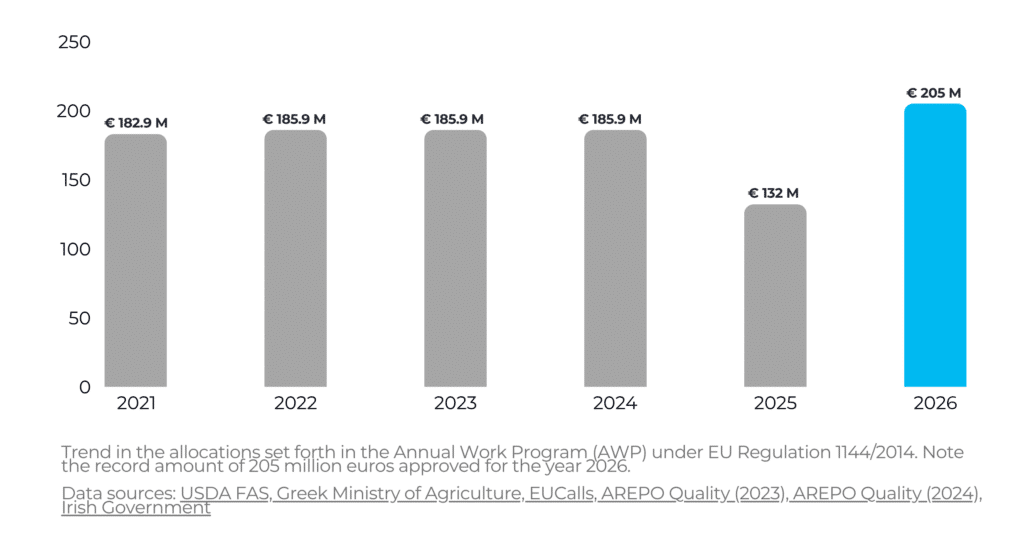
This explosion of resources is not just a budgetary matter, but a precise positioning choice. The strategic objective is the launch of the new global campaign “Buy European Food“, an institutional “venture marketing” fund designed to support exports and launch the Europe System beyond EU borders, guiding commercial flows through a massive and methodical funding architecture. 2026 thus shapes up to be the year of maximum media firepower to launch the Europe System beyond community borders.
The 50% Club and the Italian dominance of Protection Consortia
Access to these massive funds rewards exclusively the “heavyweights”. Regulation 1144/2014 imposes the criterion of “representativeness”: to submit a project, consortia must prove they represent more than half of the reference national or regional sector (in terms of value and volume). This ruthless sieve favors large historical players and, with the elimination of state co-financing to prevent competition distortions, only those with solid capitalization can afford to cover their share of the costs (ranging from 15% to 30%).
In this scenario, Italy dominates the market, having intercepted approximately 34.3 million euros with 19 leading projects in the latest round. The secret weapon? Our Protection Consortia (Consorzi di Tutela), which, enjoying erga omnes supervisory powers, instantly clear the representativeness threshold. Italy does not do simple advertising; it deploys a true bureaucratic and commercial machine. Examples include the bimodal strategies of the Pecorino Romano Consortium (to consolidate Italy and Germany and attack Japan) or the three-year programs of Parmigiano Reggiano in complex markets such as the UK and Australia.
From “Made in Italy” to “Green Deal”: the new ethical narrative
However, the narrative is undergoing a genetic mutation: Europe no longer finances gastronomic “nationalism”. To obtain funds, it is no longer enough to say that a product is good or traditional; it must be ethical. In this context, marketing is shifting from flavor characteristics to social benefits, with budgets often “ring-fenced” (restricted) for ecological transition themes. The mandatory story angles are now dictated by the Farm to Fork strategy:
-
Environmental sustainability: reduction of the carbon footprint and low-impact methods.
-
Animal welfare: high and certified standards throughout the entire supply chain.
-
Organic regimes: the promotion of organic as a pillar for the planet’s future. Agencies today are forced to transform dry technical protocols into emotional storytelling capable of competing with the direct marketing of American or Pacific-based players.
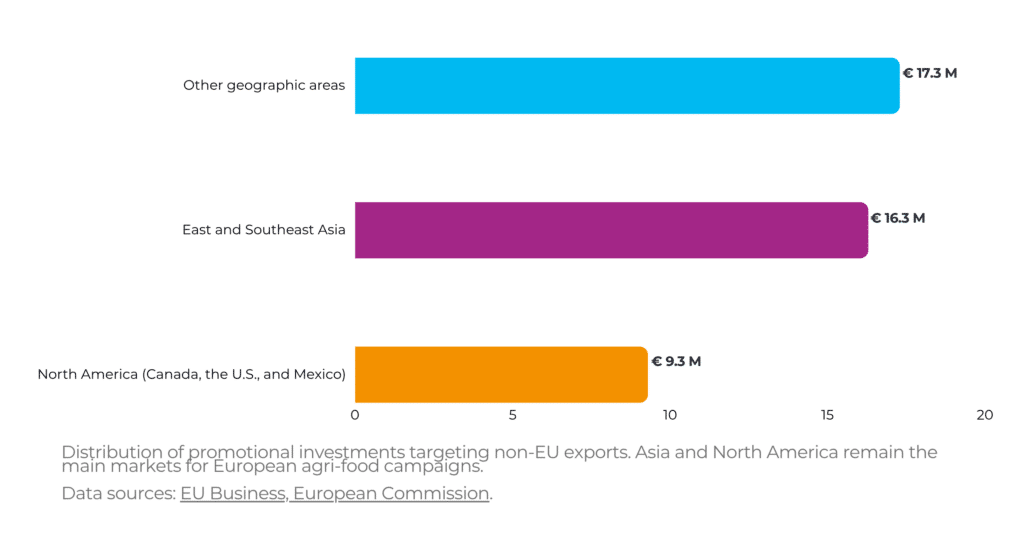
Parallelly, the map of priorities is also changing. East Asia and Southeast Asia are the priority targets with 16.3 million euros. The reason is strategic: the Asian middle class sees in Italian cuisine not only luxury, but a guarantee of food safety and traceability—fields in which DOC, DOP, and IGP certifications have no rivals. Conversely, the approach towards North America (9.3 million) is predominantly defensive. Here, campaigns act as a shield against the “Italian Sounding” phenomenon, educating consumers to distinguish the authenticity of real Italian cuisine from local imitations.
The engineering of success: beyond execution, strategic Governance
Forget improvised creativity. These projects are rigid structures divided into 8 “Work Packages” (WP) that analytically map out every phase of the funnel, from PR (WP2) to B2B trade fairs (WP6), down to the point of sale (WP7), where every step is coded and monitored according to rigorous European standards. The true competitive breakthrough, however, lies not in simple bureaucratic execution, but in the strategic Governance of whoever orchestrates these flows.
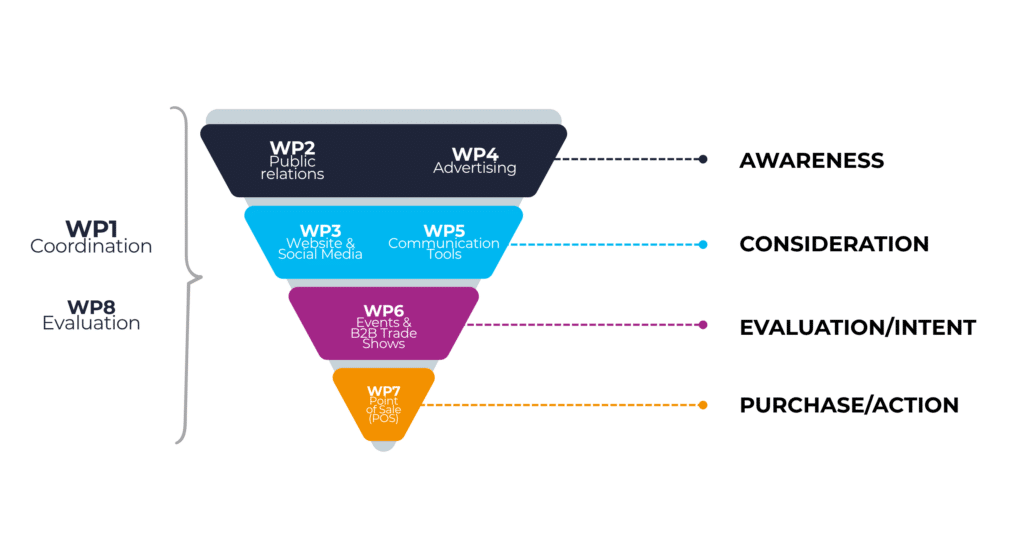
In this complex ecosystem, Spencer & Lewis acts as a true “One Agency”, capable of governing the entire funnel through its hubs and an international network spanning over 20 countries. Emblematic is the 3.6-million-euro project won for the promotion of the Parmigiano Reggiano Consortium in the United Kingdom. As the executing body and general contractor, Spencer & Lewis does not limit itself to executing Work Packages, but acts as a strategic partner that orchestrates this vast network of expertise to maximize business results, challenging itself directly on objectives and bringing added value that goes beyond the single operational task, turning every initiative into a multi-year growth engine for brands within the complex post-Brexit international landscape.
The effectiveness of these massive investments is not simply presumed or declared, but rigorously certified through scientific evaluation protocols. The EU regulatory framework demands that an independent, third-party evaluator, such as the prestigious Nomisma Institute, methodically analyzes the real macroeconomic impact and the actual shift in brand perception within target markets. This process ensures that the 205 million euros injected annually into the system are not just an expense, but produce a traceable, quantifiable, and sustainable return for the entire European agri-food ecosystem.
Why food has become a geopolitical act
The excellence of Italian cuisine does not survive on global markets just because of taste. Behind every slice of prosciutto or wheel of cheese consumed in Tokyo, there is a massive financial architecture and a planning strategy that leaves nothing to chance. Europe has decided that food is a political act and a powerful tool of global influence, a reputational armor to defend the value of our supply chains.
The next time you choose a certified DOC, DOP, or IGP product, will you ask yourself whether you are doing it for the authentic flavor of Italian cuisine or because a sophisticated European marketing algorithm decided it was time to win you over?