Strategic communication isn’t about what you write. It’s about what you decide
by Massimo Romano
Today, talking about strategic communication means dealing with a scenario where the winner is not the one who produces the most, but the one who makes better decisions. When your competitor becomes your best press office, you probably haven’t just run a good campaign. You have made—or suffered—a strategic decision.
The recent event involving Iliad and Fastweb is a perfect example of how communication today is no longer played out solely on the execution level, but on that of strategic choices.
Iliad uses Megan Gale, a face that belongs to the collective imagination of Italian telephony. A simple, recognizable operation, almost automatic to decode. On its own, it would have remained within the boundaries of advertising.
It was Fastweb‘s reaction that completely changed the trajectory of the campaign.
In an attempt to limit its reach through a formal warning, Fastweb turned it into news. They pushed it outside of the planned media spaces and inserted it into the public conversation. This triggered a mechanism very close to the so-called Streisand effect, whereby the attempt to block content inevitably amplifies its visibility.
At that point, the campaign completely changes its nature.
It is no longer “the commercial with Megan Gale”. It becomes “the commercial that someone wants to stop”.
And this is where a dynamic increasingly typical of contemporary communication is activated: in the attempt to limit content, one ends up amplifying it.
Those who hadn’t seen the campaign start looking for it. Those who probably wouldn’t have talked about it begin to discuss it. The advertisement exits its planned spaces and enters the public conversation. Whether it was a fully conscious choice or an instinctive reaction matters little. The point is that, from that moment on, the trajectory of the campaign is no longer defined by creativity, but by the decisions made around it.
The true blind spot of communication
This episode highlights a structural problem in contemporary communication. Companies are increasingly equipped to produce content. They have tools, teams, processes, and platforms. But they are much more rarely structured to govern the decisions that such content generates.
In an accelerated context, where everything can become visible in a matter of minutes, the pressure to react is continuous. Every stimulus seems to demand a response. Every attack, a stance. And often, this reactivity is mistaken for strength.
But reacting is not always a strategy. Sometimes, it is the reaction itself that generates the problem.
The paradox of noise
This is the exact same paradox we already observed when talking about AI Slop: in an ecosystem where producing content is easier than ever, the risk is not communicating too little. It is communicating without a direction.
Under pressure, many companies fill spaces. They publish, reply, and maintain a presence. But when communication is born to occupy a timeframe or a channel, rather than from a strategic choice, the result is inevitable: noise.
From Forum Comunicazione 2026 to operational reality
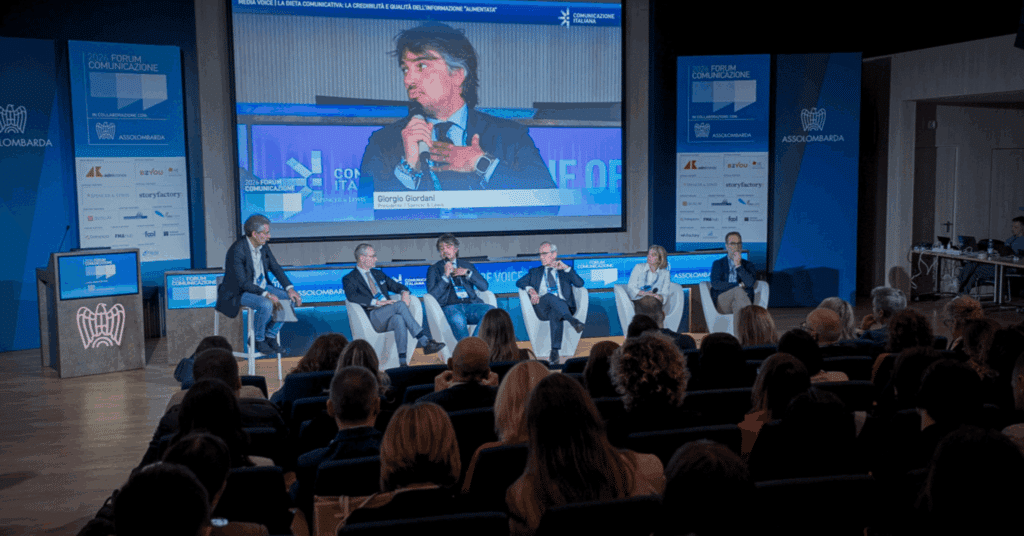
At the Forum Comunicazione 2026, this theme emerged with great clarity. Marketing is no longer just execution, but choice. And choice is not only about what to say, but also—and above all—what not to say.
In a context where data is increasingly abundant and accessible, another paradox emerges: we have more information than ever, but often less capacity to make decisions. The difficulty lies not in gathering data, but in translating it into a clear direction. In simplifying what is complex. In making choices that, by their very nature, are not simple, understandable and relevant.
From execution to governance
This is where the most important shift takes place. Strategic communication does not fail because it is poorly executed. It fails when it is driven by impulsive, fragmented, or ungoverned decisions.
For this reason, the issue today is no longer just executive. It is about governance.
Understanding when to intervene.
Understanding when to let things fade away.
Understanding when a reaction truly defends a brand and when, instead, it ends up amplifying the problem.
At Spencer & Lewis, we work exactly at this level of communication: helping companies read the context before reacting, governing decisions and not just content. Because today, control does not belong to those who speak the most. It belongs to those who manage not to get dragged into other people’s narrative games.

Choice as a competitive advantage
In contemporary marketing, the difference is not between those who communicate well and those who communicate poorly. It is between those who react and those who decide.
In the Iliad–Fastweb case, one decision amplified the message. The other knew how to ride that amplification. And that is exactly where you see the true level of contemporary strategic communication: not in the quality of execution, but in the ability to govern what happens around it.
Because when everything can be said, the true competitive advantage is knowing what not to say.