Refurbished smartphones: the antidote to rising technology costs that can save families up to €2,500
In an economic landscape marked by the constant rise in the price of electronic devices, the circular economy is no longer just an environmentally responsible choice—it has become one of the most effective ways for households to reduce expenses.
Refurbished smartphones are among the most effective solutions for offsetting the rising cost of technology. This is confirmed by a new study conducted by Fraunhofer Austria, commissioned by refurbed—Europe’s leading marketplace for refurbished products—which scientifically measured the financial and environmental impact of different purchasing, usage and end-of-life scenarios for tech devices.
The announcement comes at a pivotal moment, just ahead of the national implementation of the European Right to Repair Directive, legislation set to reshape the market by promoting greater transparency and extending product lifespans.
When evaluating the economic or environmental impact of a smartphone, people often assume that the purchase price or disposal method are the most important factors. However, the Fraunhofer Austria study overturns this assumption, demonstrating that the way products are managed throughout their lifecycle has the greatest overall impact on both costs (direct and indirect) and emissions.
A smartphone kept in circulation for longer generates only about one-quarter of the costs associated with a product used in a traditional linear “take-make-dispose” model. Simply by adopting a more conscious approach—extending a device’s lifespan and taking advantage of trade-in programs—a consumer can reduce smartphone spending by approximately 25%.
To map these dynamics, the research institute analyzed the six-year lifecycle of an average smartphone with a new retail value of €575, identifying three different usage scenarios.
Scenario A – The linear, disposable model
The smartphone is replaced every year with a new model, while old devices accumulate unused at home before eventually entering illegal recycling channels in developing countries.
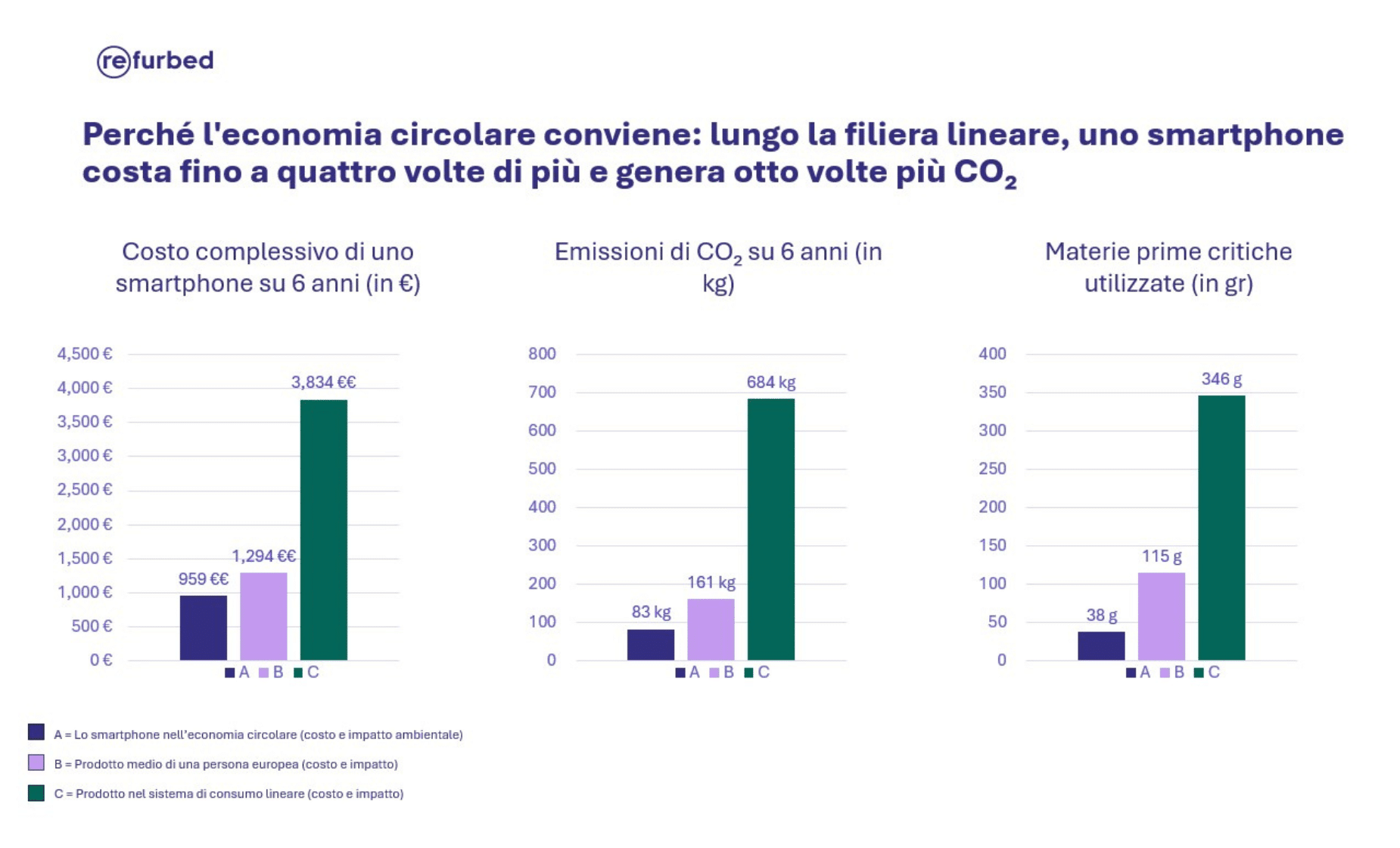
Total cost over six years: €3,834 (€3,450 purchase costs + €384 environmental costs), equivalent to around €639 per year—four times more expensive than the circular model.
Environmental impact: A single user generates 684 kg of CO₂ (eight times more than under the circular model) and consumes 346 grams of rare earth elements and metals (nine times more).
Scenario B – The typical smartphone lifecycle in Italy
This reflects the average lifecycle of a smartphone: it is used for three years, then forgotten in a drawer—locking away valuable resources—before eventually being discarded with household waste.
Total cost over six years: €1,294 (€1,150 purchase costs + €144 environmental costs), or approximately €215 per year.
Key finding: Compared with the circular model, this average lifecycle generates nearly 35% higher costs, twice the CO₂ emissions, and almost three times the consumption of critical raw materials.
Scenario C – The circular model (choosing refurbished)
The smartphone is purchased once, used for approximately three years, returned through a trade-in program, professionally refurbished for a second owner for another three years, and finally professionally recycled.
Total cost over six years: €959 (€876 purchase costs + €83 indirect environmental costs related to CO₂ emissions), equivalent to around €160 per year.
Environmental impact: Only 83 kg of CO₂ emissions and just 38 grams of critical raw materials (including cobalt, copper, magnesium and palladium) are consumed.
Product-focused analysis
The study deliberately analyzed data at the level of individual products rather than user categories.
“For us, it was essential to calculate results on a product basis rather than by specific user groups, in order to avoid unfairly blaming consumers,” explained Paul Rudorf, author of the study at Fraunhofer Austria. “Every product must first be manufactured, which already involves costs and an initial environmental impact. What happens after production is what truly makes the difference: product lifespan, usage patterns and disposal have a significantly greater impact on both consumer costs and the environment.”
The iPhone 15 case
The transition toward circularity is far from being merely theoretical, as demonstrated by large-scale data published in refurbed’s latest Sustainability Report. Since its foundation, the platform’s community has given a second life to more than 10 million refurbished devices, saving a total of 474,000 tonnes of CO₂, 166 billion litres of water, and 1,555 tonnes of electronic waste.
A practical example of this efficiency is the iPhone 15. Over the past year, the refurbished version of the device available on the refurbed marketplace has been, on average, 46% less expensive than a brand-new model, while also reducing CO₂ emissions by 84%, water consumption by 87%, and the use of critical raw materials by 68%.
These high standards of ethics and transparency have enabled refurbed to further strengthen its position through the prestigious B Corp Certification.
The impact for consumers and the European economy
“At a time when we are clearly experiencing the negative effects of resource dependency, and studies show how poor Europe is in terms of raw materials, adopting a circular model becomes both an economic and a personal cost factor,” said Kilian Kaminski, Co-Founder of refurbed. “The data clearly demonstrates the savings potential: simply by adopting more responsible usage models—such as reselling devices, extending their lifespan or disposing of them correctly—consumers can save at least €274 and up to €2,574 per device over a six-year period. And these figures are based on an average smartphone; savings for iPhone models are significantly higher.”
The impact for businesses
While consumer savings are evident, the findings also send a strong message to businesses and corporate procurement strategies.
“Many companies are still very close to Scenario A in the way they procure technology,” said Kilian Kaminski, Co-Founder of refurbed. “The Fraunhofer Austria data clearly demonstrates the savings potential for companies that transition to a more circular procurement model for smartphones and laptops. Especially in times of economic pressure, these considerations become extremely relevant.”
Applying a circular approach to technology delivers three key financial benefits:
- Lower upfront purchasing costs.
- Tangible return on investment through trade-in programs.
- Reduced indirect environmental costs thanks to the reuse of materials and critical resources.
As an additional monitoring tool, refurbed now provides consumers with an online calculator (https://productfootprint.app/en/), an interactive tool that enables users to quantify in real time the exact amount of resources saved by choosing a refurbished device.
For further information: Spencer & Lewis for refurbed.