Being sustainable matters. But when the moment comes to make a purchase, it isn’t always enough.
Over the years, a significant portion of sustainability communication has built its narrative around individual responsibility: buying less, choosing lower-impact products, repairing instead of replacing, and favoring circular consumption models.
While these arguments are important, businesses face a very concrete problem: a shared value does not automatically translate into a purchasing choice.
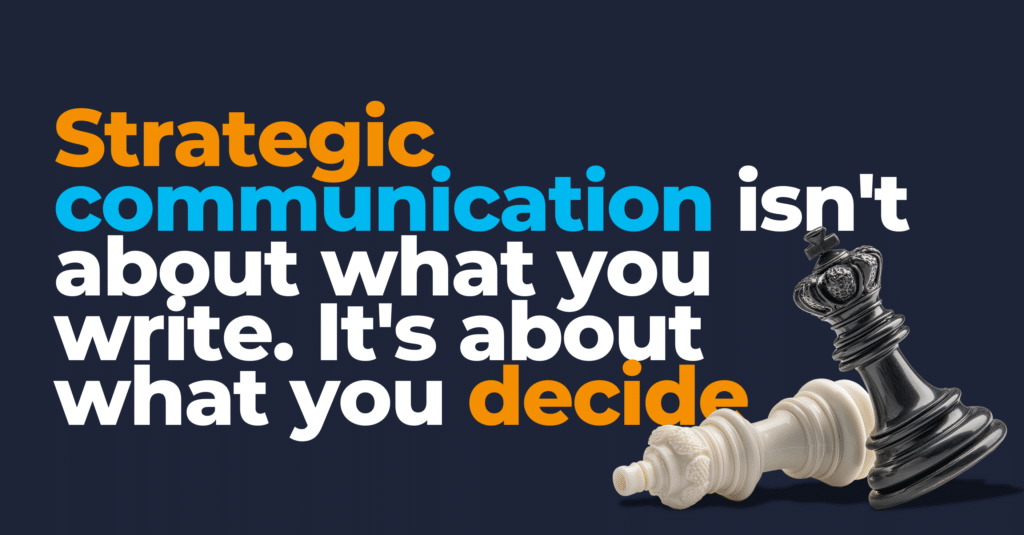
This is precisely where, for Spencer & Lewis, sustainability work moves beyond standard ESG communication to become positioning advisory. Before crafting a message, the real question is different: which element of the company’s sustainable model is relevant enough to directly influence market decisions?
Because if sustainability remains detached from convenience, product value, and economic goals, it risks generating consensus without driving actual behavior.
The bottleneck of sustainability framed as a sacrifice
Asking people to alter established habits solely in the name of a collective benefit inevitably introduces friction.
Consumers may fully support an environmental goal while simultaneously choosing a less sustainable product because it costs less, is easier to purchase, or seems more reliable.
For a brand, the solution cannot be achieved simply by attaching an environmental claim to its communication. What is needed is identifying whether there is a point where what is good for the environment also delivers a clear advantage to the buyer.
This shift directly involves the role of the advisor: reading data, product, positioning, and consumer behavior together before deciding which story to tell.
An effective communication strategy should never ask the market to ignore its own interests. Instead, it should pinpoint the moment where individual interest and environmental goals begin to align.
From value to advantage: the refurbed case study
This core assumption guided our work with refurbed.
The refurbished model inherently offers a clear environmental benefit: extending product lifecycles reduces the need for new manufacturing and limits resource consumption. However, relying solely on this narrative would have relegated economic convenience to the background, continuing to ask consumers to choose primarily “because it is more sustainable.”
Instead, the study conducted by the Fraunhofer Austria Research Institute provided a much broader set of insights into the economic and environmental impacts of different tech consumption models.
Our objective was to extract, from that scientific complexity, the data with the highest potential relevance for the market and convert it into a positioning driver.
Rather than merely publicizing a study, we aimed to determine which evidence could genuinely alter product perception.
Two particularly powerful figures emerged from this analysis:
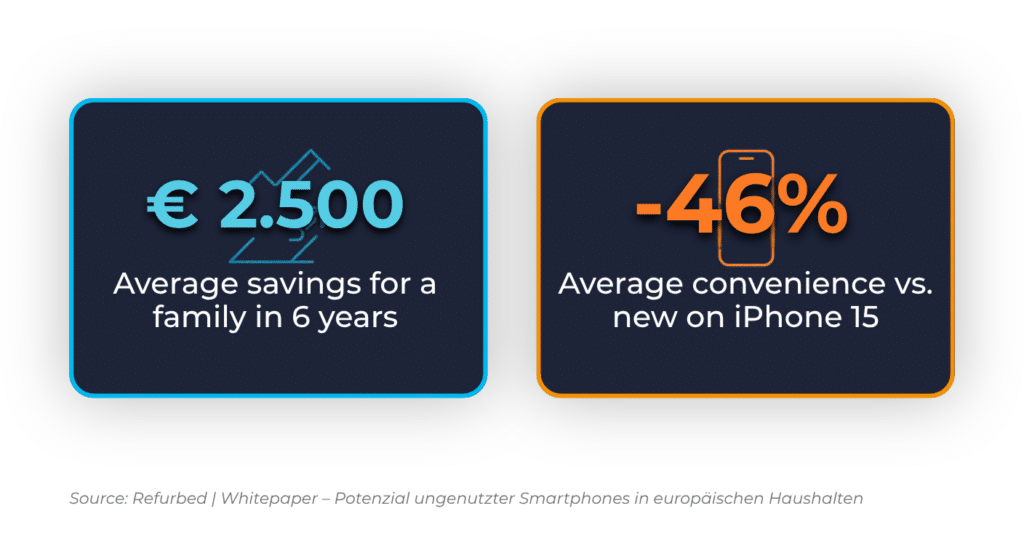
- By adopting circular habits, family savings can reach approximately €2,500 over a six-year period;
- In the case of the analyzed iPhone 15, the refurbished version was an average of 46% more cost-effective compared to buying new, alongside a reduced environmental impact.
At this point, scientific data ceases to be merely supporting proof for an ESG claim and becomes a commercial and reputational asset.
The message shifts: Not just: “Choosing refurbished reduces environmental impact.” But: “There is a consumption model that can cost less while simultaneously using fewer resources.”
Sustainability is not downplayed. On the contrary, it gains strength because it is tied to a concrete purchasing driver.
Having the right to repair doesn’t mean choosing to do it
This same principle becomes even clearer when examining the topic of repairs.
The new Right to Repair framework aims to remove obstacles that make extending device lifespans difficult. However, refurbed highlighted a decisive point: making repair possible does not automatically make it convenient.
If the price of a replacement part or service approaches the cost of a new device, the legal right exists on paper but loses most of its power to alter behavior. This is why refurbed also emphasized the need for transparent spare part pricing and tangible incentives for reuse and repair.
For corporate leaders, however, this regulatory transformation opens a much broader question.
Today, a brand communicating its sustainability navigates two opposing reputational risks:
- Greenwashing: Promising more than data, products, and processes can demonstrate.
- Irrelevance: Complying with new standards and obligations without turning them into something meaningful for the market.
It is precisely within this domain that Spencer & Lewis operates as an advisor.
Reading compliance alongside its reputational and competitive implications means understanding which elements can support a strong public stance, which require further proof, and which should not be turned into a claim at all.
Not everything a company can say is worth saying, and mandatory compliance does not need to remain trapped in the language of compliance. When a real, demonstrable benefit exists, strategic work consists of making it understandable as a competitive advantage.
Where ESG, business, and consumer drivers meet
This is perhaps the most relevant point for corporate leaders guiding marketing and communications today.
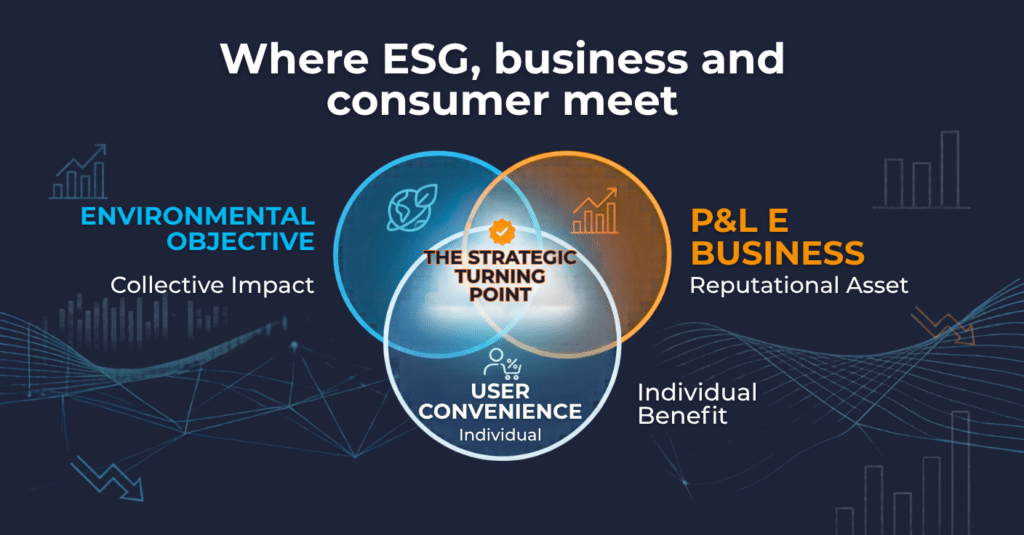
The role of a strategic advisor is not simply finding a clever formula to convey an ESG goal. It is building the matrix where the client’s environmental goal meets the company’s P&L and consumer convenience.
These three dimensions are far too often managed in silos:
- Sustainability, environmental goals, and reporting.
- Growth, margins, positioning, and competitiveness.
- Consumer motivation: price, quality, reliability, longevity, and simplicity.
At Spencer & Lewis, our work starts at the intersection of these three levels.
In refurbed’s case, financial savings make individual benefits immediately clear; environmental data proves collective value; and unifying both within a single narrative builds a stronger reason to choose the brand.
This also means changing how we measure the ROI of sustainability communication.
It is no longer enough to measure how many times an ESG message was published or how much reach it achieved. The critical question for a CMO is: Did that evidence help strengthen a brand preference?
Because that is the precise moment sustainability moves beyond reporting to actively work for the business.
From declared sustainability to demonstrated sustainability
For this reason, at Spencer & Lewis, we operate upstream of message delivery.
We validate the solid foundation of available evidence, subject it to a relevance stress test to determine what truly matters to the market, and identify proof points capable of supporting a distinctive and defensible positioning.
We do not help brands make bolder claims. We help them understand what value they can genuinely demonstrate and how to turn it into a leverage point for reputation and business growth.
This means distinguishing between a merely positive metric and data capable of becoming news. It requires connecting research, regulatory landscapes, media environments, consumer behavior, and executive business targets. Ultimately, it means deciding—before execution—which story actually makes sense to build across PR, media relations, content, and corporate touchpoints.
The refurbed case demonstrates this method:
- The environmental data was already there.
- The economic advantage was already there.
- The scientific report was already there.
The strategic advisory value lay in identifying the exact point where these three elements form a market position.
This is likely the most critical challenge for sustainability communication in the coming years: not persuading people to choose a sustainable option despite higher costs, complexity, or inconvenience, but helping companies build, demonstrate, and clarify the exact moment where consumer interest, environmental strategy, and economic value cease to be three separate stories.
Because when making the sustainable choice also means making the convenient choice, sustainability stops being a statement of principle and begins to drive real behavior.